Showing posts with label classic children's books. Show all posts

Monday, September 3, 2012

The Last Unicorn, by Peter S. Beagle

First published in 1968


The Last Unicorn is one of my absolutely favourite books. I think Peter S. Beagle is one of the finest writers around – an absolute master of beautiful language, unique characters, imagination, warmth, humour and magical storytelling. He is one of those writers who can sum up grand emotion in a succinct, unique line. If you love fantasy and children’s books, then Beagle is an author who must be read. He has many fine stories – but my favourite is the very gorgeous The Last Unicorn.

I have a journal where I keep passages or lines from books that I think are particularly fine or moving – those lines that give you shivers – and The Last Unicorn features prominently in it. What he does best is write lines that illustrate loneliness and confusion; that really reach down into those emotions we keep embedded and tease them out of us. But these lines are never sappy or trying to be quote-worthy – they are often whimsical and silly and simple, but the resonance sweeps through all the pages. Beagle understands mortality, and people’s fears, and the many different guises with which they hide them. I love how he shows us the cracks in all his characters – he does it with such profound beauty and understanding.

The Last Unicorn may read like a fairytale – it has a princess and a prince; it has a quest and adventures through all the hidden parts of the world; it has a baddie and a beast, and it has secrets and a wicked adversary who is as evil as they come. Even just as this, it is a great story. But it is also very clever, and Beagle uses a tone that makes fun of it all but never snarkily, always with affection. There is a great sensitivity woven through all the pages and a sense of fun that subverts the genre even as it faithfully follows all the tropes.

One of the greatest things which keep The Last Unicorn rollicking along is that it is genuinely funny. The characters; the situations they find themselves in; the double-crosses; the human folly; the fabulous one-liners that flow so effortlessly. The pure, dazzling silliness of it all. My particular favourites are the talking skull and the magician Schmendrick when he is called upon to get himself out of a sticky situation or is making fun of everyone around him. His wit is legendary.

Which leads us to the characters in The Last Unicorn. They are all fabulous; nuanced; believable; entertaining; empathetic. I love the Unicorn and her motley crew – the lonely, sarcastic, jealous magician Schmendrick who cares too much; the bitter, no-nonsense Molly Grue with a heart of gold, and later, Prince Lir who believably and heart-breakingly emerges from a soft fool into a noble, hardened prince. The Unicorn herself, who is so brave and beautiful – but, for all her power, as full of doubts and weaknesses as her human companions.

But it doesn’t stop there. The baddies – most notably King Haggard and Mommy Fortuna – are glorious, complex characters who spit bitterness and hate but who, through a simple line from Beagle, reveal the fears and the insecurities that drive them to be so. And then all the other characters who float in and out of the pages – the talking cat, Captain Cully and Jack Jingly, the royal magician Mabruk, to name a few – are colourful, humorous creations, written with real warmth and imagination.


Imagination is where The Last Unicorn really wins for me. It is a wonderful concept in itself – being the last of your kind. The loneliness, the responsibility, the sadness in such an idea – I find this fascinating (which also tells me probably why I like Doctor Who so much – oh the adventures he has, but always and only ever, by himself). Everything that Beagle fills the pages with after this particular idea is just a bonus. The whole book just feels so graceful and enchanting – the kind of magic that you can’t shake off.

And really, it comes down to Beagle – his writing, his style. Read one of the first scenes between the Unicorn and a stray butterfly and you will understand something of his power. In this scene he uses words and ideas and emotions and weaves them together all so seamlessly, so powerfully, in the form of an erratic, dying butterfly. Brilliant. His writing is beautiful and effortless, and this, above all, is what makes The Last Unicorn such a triumphant children’s classic.


Previous entries, my fav Children's Books:

Number 20:  Peter Pan by J. M. Barrie

Number 19:  The Neverending Story by Michael Ende

Number 18:  Tuck Everlasting by Natalie Babbitt

Number 17:  The Toymaker by Jeremy de Quidt

Number 16: The Thirteen Clocks by James Thurber

Number 15: The Scarecrows by Robert Westall

Number 14: Watership Down by Richard Adams


Wednesday, August 29, 2012

Farewelling Literary Greats

Great article from Publishers Weekly on those influential, fabulous children's authors we have farewelled this year. I love this article, not only for the sentiment, but because it highlights some truly important children's authors and their works - including one of my personal favs, SF writer Ray Bradbury.


Sunday, June 17, 2012

Frog and Toad Together by Arnold Lobel

So I recently found out that Arnold Lobel's Frog and Toad is going to be made into a film by the Jim Hensen film company. What a great time to spotlight these gorgeous, classic characters and their adventures.

The Frog and Toad stories are first chapter books, intended for young children just starting to read on their own. The language is simple with lots of 'vocabulary list' type words, short sentences, and large writing. Half and quarter page illustrations accompany the text, depicting Frog and Toad in a lovely soft green/grey colour palette. I love the illustrations. They are a fantastic accompaniment to the text, and also very revealing of Frog and Toad's characters.

Of the two, Frog is the smarter one - outgoing and forward-thinking - while Toad is slightly more neurotic and grumpy, and quite reliant on his friend. But their friendship is gorgeous. I have a battered old copy of Frog and Toad Together, and I have always found Lobel so accomplished in depicting a multitude of feelings with so simple a vocabulary. The Frog and Toad books not only encourage kids to read on their own, but also introduces them to subtle messages and themes.

The main theme is, of course, friendship. But the short stories are packed full of virtues like patience, bravery, resourcefulness and appreciation. But Frog and Toad are not perfect. The stories also gently demonstrate how they suffer from folly, arrogance and greed - but never in an overbearing way, always with a lovely whimsical inclination. I love that a 'first reader' book can show characters with bad qualities and imperfections. And while the books don't excuse these traits, they do show that they are a part of human (amphibian!?) nature, and perhaps how to move past them with more positive attributes.


But of course, what is really so lovely about these simple little stories is the depth of Frog and Toad's friendship. I can always see them, together in the countryside, keeping each other company and going on adventures and it always makes me feel kinds warm and fuzzy and a little nostalgic. My favourite Frog and Toad moment is in the story 'The Dream'. Toad is dreaming he is a great performer on stage, and Frog is watching him. With each act of Toad's spotlight-hogging brilliance, Frog gets smaller and smaller until he disappears, and Toad realises what is really important is not that he is the greatest or best, or even better than Frog, but just that Frog will always be there for him:


"Come back, Frog," he shouted. "I will be lonely!"
"I am right here," said Frog.
Frog was standing near Toad's bed. "Wake up, Toad," he said.
"Frog, is that really you?" said Toad.
"Of course it is me," said Frog.
"And are you your own right size?" asked Toad.
"Yes, I think so," said Frog.
Toad looked at the sunshine coming through the window. "Frog," he said, "I am so glad that you came over."
"I always do," said Frog.


Friday, April 13, 2012

The Scarecrows by Robert Westall

First published in 1981

The Scarecrows was first published in 1981 – it’s more of a recent children’s classic, but rightly so, because it’s one of the best contemporary children’s novels I’ve read. I say contemporary even though The Scarecrows does have elements of horror and the supernatural – but these things arise out of the main character’s psychological trauma. The way Westall does this is seamless and powerful. Some of the content is quite daring – a few of the passages would not make the final edit these days, I feel – but at the same time, it feels like they need to be there. These things make us understand the fear, isolation and confusion Simon feels as the realities of being ‘grown up’ push their way into his life.

Simon is thirteen years old and The Scarecrows deals with how he copes in the face of his mother’s remarriage. He feels betrayed by her, and he feels she has betrayed the memory of his dead father. At boarding school he is often taken aback by fits of rage, which he describes as the devils coming in. When his mother remarries and he goes to stay with them at Mill House, the devils chase him there too, and eventually get the better of him in the climax.

What I loved about this book is the perception in it. Simon’s thoughts and feelings ring so true. Often when I come across a passage in a book that ‘just gets it’ – where the emotion and insight is just so spot on, often where it cuts into your heart – I dog-ear the page (bad, I know) so I can come back to it later and savour the perfection. There were a lot of dog-ears in this book.

Westall was so clever when he created the Simon character – I think certainly he is unlikeable, but we always understand where his actions and thoughts come from. He is never whiny or sulky or bad-tempered – he is just hurting, and we can feel this. He is quite funny and endearing, in his own way. We know he cares. We know that he knows many of his actions are wrong. But we understand why he does it. Just brilliant characterisation. I particularly loved Chapter Four, the scene with his mum in the car. It plays out so perfectly – Simon knows he is making things worse, is digging himself deeper and deeper. But he can’t, won’t, give in: when you’re hurting so much the only way to stop it is to make yourself hurt more – this just leaps off the page.

The Scarecrows is genuinely, for a kid’s book, scary. And what makes it even more terrifying is that the horror comes from the ugliness of human emotions. This is a psychological thriller at its best. Three scarecrows in a field and a decrepit mill – in Westall’s hands, these things are truly frightening. When Simon first sees the scarecrows in the field and goes to investigate – I think my eyes were bugging out of my head. Great atmosphere. Simple, but effective writing.

I also found this book to have a great balance. There is some genuinely funny stuff, like when Simon climbs up the tree to spy on Joe painting. His stubbornness itself makes me smile. There is also great emotional truth. The periphery characters are fantastic – Jane is such a little creation, and Mr Mercyful commands the pages he’s in. And the historical back story never intrudes but only enhances the main setting and story.

The Scarecrows is fantastic and a must for school libraries. It is one of the only realistic/contemporary-based children’s classics in my Top 20 list. Past entries included below:


Number 20:  Peter Pan by J. M. Barrie

Number 19:  The Neverending Story by Michael Ende

Number 18:  Tuck Everlasting by Natalie Babbitt

Number 17:  The Toymaker by Jeremy de Quidt

Number 16: The Thirteen Clocks by James Thurber

Coming soon: Watership Down, by Richard Adams

Thursday, February 16, 2012

The 13 Clocks, by James Thurber

First published in 1950


When I first read James Thurber’s The 13 Clocks, my mind was blown. I was in my first year of Uni and the library had such an amazing collection of children’s books, especially old classics. Many of the books I read in this period have become some of my favourites, and are what really, really, made me have so much love for this genre.

One of these books was The 13 Clocks.

I had never come across anything like it before. I remember marvelling at the cleverness of it, and being delighted and then moved by the characters (especially that most wicked of Dukes), and just being so completely taken in by the ease with which Thurber used language in such creative and challenging ways.

The 13 Clocks is a fractured fairytale. It begins with Once Upon a Time and ends with Happily Ever After but everything that comes in between is about as original as you can get.  Thurber subverts the genre in much the same way as Shrek and The Princess Bride do, but overall I find the irony to have a bit more of a bite.

The Prince, with the help of the Golux, must bring back the evil Duke one thousand jewels within nine and ninety hours or he will be ‘slit from his guggle to his zatch’, fed to the Todal, and lose Princess Saralinda to the wicked ways of the Duke. Sounds straightforward, and indeed, the tale is a good one. But the fun, and the brilliance of the story, can really be found in the wonderfully weird and wacky way Thurber tells it.

I think a love and understanding of fairytales, language and writing helped me develop the huge amount of admiration I have for this book. If a plot device can be exploited, it will be; if a sly aside or knowing wink can be dropped, it will be; if stylistic language choices can be made fun of, or drawn attention to, they will be (A morning glory that had never opened, opened in the courtyard. A cock that never crowed, began to crow. The light of morning stained the windows, and in the walls the cold Duke moaned, “I hear the sound of time;” and if character names can be outrageously self-referential, they will be.

This is why I love The 13 Clocks – because it is, I think, above all about a love of language. Amongst all the sly cleverness there are some lovely thoughts, passages, and imagery – like clocks being murdered and spilling their cogs and springs onto the stairs. The story in itself is also a rollicking adventure, with a few twists and reveals and high stakes. But it is also so gloriously silly, with things happening just because they can. One of my favourites is:

“A purple ball with gold stars on it came slowly bouncing down the iron stairs and winked and twinkled, like a naked child saluting priests. “What insolence is this?” the Duke demanded. “What is that thing?”
“A ball,” said Hark.
“I know that!” screamed the Duke. “But why? What does its ghastly presence signify?”

All sorts of irrelevant objects and happenstances are placed into the story in such an affectionate self-referential way. The story has fun with itself. The language has such fun with itself – for example the story will switch in and out of rhyme, and even when it doesn’t rhyme, there is an obvious metre used, a rhythm to what words are used and when. And all of it just completely sweeps you up and takes you away.

And yet the characters, for all their silliness, and the relative shortness of the book, feel familiar almost straight away. I found myself becoming invested in them and getting sucked into their crazy existence. I think where The 13 Clocks really wowed me was that Thurber, even among all the silliness, can tweak emotions so very subtly. A lot is revealed about the characters through just one line, or thought.

The Duke is particularly well done. He is so very mean and cruel – “We all have flaws ... Mine is being wicked” – his dark humours are hilariously appalling, and he is gloriously tempestuous. But he is also sad. And lonely. Thurber shows this in his obsession with slaying time, his thoughtless repetition of commands, the way he slashes “his sword at silence and at nothing.” Princess Saralinda and the Prince give the books its fun, the Duke’s henchmen give it comic relief, and the Golux gives it all its mischief and silliness. But I have always found, perhaps strangely, the evil Duke to give the book its heart.

I couldn’t love The 13 Clocks more if I tried. It is hard to find these days, but there is a newish wonderful hardback, illustrated edition with an introduction by Neil Gaiman, published by the New York Review Children’s Collection. If you can find it, this book will be well worth your time.

Sunday, February 12, 2012

My Top 20 Classic Children's Books

In the last couple of months of 2011 I had grand ambitions to read ten children’s classics by the end of the year. Well surprise, it didn’t happen. Kind of picked the busiest months. And also in those few months I was also working on something a little closer to home – more on that in the next few posts.

Nevertheless, it’s still something I want to do, and so have changed it slightly – now it’s going to be my Top 20 classic children's books, which I will read (well, re-read really) and blog about. I’m excited about this because these books will be my absolute favourite children’s books – the ones that moved me so indescribably, that inspired me, the ones that I consider the greatest books in children’s literature. These are the ones that I buy in gorgeous hard copy editions and pick them up and coo at them (maybe not really ... perhaps just a little) and I can’t wait to share my thoughts on them.

For the record, the three books I started to review last year were The Graveyard Book, Journey to the River Sea and The Neverending Story.

Some of my favourite children’s books I have already reviewed on Book Grotto, so I will begin the countdown with them. (The Countdown will not be in order of favourites, it will really just be as I read and post about the books). And of course I would love to hear everyone else's thoughts on their favourite children's books as well.


So without further ado:

Number 20:  Peter Pan by J. M. Barrie

Number 19:  The Neverending Story by Michael Ende

Number 18:  Tuck Everlasting by Natalie Babbitt

Number 17:  The Toymaker by Jeremy de Quidt

And coming in the next few days:

Number 16: The Thirteen Clocks by James Thurber


Wednesday, January 11, 2012

Wildwood by Colin Meloy

First published in 2011 by Viking


I kind of missed the whole ‘Colin Meloy of the Decemberists has written a kid’s book’ hype – I was excited about Wildwood because it was in all our indie book catalogues, had some great feedback in store, and looked gorgeous. It wasn’t until I picked up the book and actually read about the author that I realised who he was. So in no way does that have any influence on my reading of the book. In fact, I think it could stand alone on its own strengths.

Wildwood kind of has all the elements I think this type of middle-grade book should have. The writing is not dumbed down – there were a few sentences and word usages where I was a bit ‘really? You had to use that word?’; but it is straightforward and accessible to kids while still having that appeal that hooks in older readers. There is lots of adventure and an imaginative world that is fully immersive. There is that fantastic concept of kids being swept into the kind of world they’ve only ever dreamed about – populated by derring-do and talking animals and heroes and villains and all the weird and wacky stuff that lives in our heads. It is, really, a classic adventure story, well done and engaging. Where it didn’t quite get me was with the emotional resonance. I didn’t care so much for Prue as everything that was happening around her, and my emotions weren’t pulled into the story the way I wanted them to be. But I liked Wildwood. It was thoroughly enjoyable.

Of course, the book looks gorgeous and its design and illustrations are perfectly suited to the text. Design actually plays a big part in the way I read and enjoy books, and Wildwood is one of the best. And yes, it’s long, but I really don’t think that should deter anyone. My experience is that kids don’t mind reading long books – in fact I think they rather like having a world that they can keep coming back to.

I loved the world of Wildwood, or ‘The Impassable Wilderness’; it was a joy to travel through it with Prue and Curtis and see what would be discovered next. The maps that were included were also great. The actual forest has a lot of atmosphere but both the ‘city’ feel of Southwood and the quaint rustic feel of Northwood were written with a lot of charm.

Prue and Curtis were okay as characters, but as I said, I really wasn’t so much interested in them as in the strange world they entered into. This really is a case of secondary characters stealing the book away from the mains. And the main villains and heroes are really nothing we haven’t seen before, but Meloy does enough with them that I still found them interesting. It was the animals where characterisation really stood out.

The bulk of the story is set in the actual Wildwood, and so I didn’t care much for the ‘normal’ scenes back in Portland, especially the last six or so pages. The Wildwood scenes actually feel more ‘real’ than Prue’s normal reality, and so I don’t want to be pulled back into the mundane.

I liked it. There is a great sense of wild childhood adventure. My pick for a good Summer read.

Monday, December 26, 2011

The Neverending Story by Michael Ende

First published in German, 1979

What an important, amazing and imaginative book The Neverending Story is. It’s been a long time since I’ve read a book that can balance such magic and imagination with such insight and perception into the human psyche and the real world, and have the two inform understanding of the other. And then, above all, to do it within the framing device of the central character literally stepping into a book that teaches him all these things, and at the same time relies on him to keep creating the stories within. So clever, and so much fun.
I have read Momo by Michael Ende, and wasn’t such a fan – it was just a little too preachy and twee for me. The Neverending Story has a similar sort of intellectual whimsy, but I found I could stomach it better. Perhaps because the over-arching message is quite beautiful, and the way the central figures, Bastian and Atreyu, discover these things is through exposure to such wonderful things and creatures, whose beauty and magic helps them realise very human things like courage and individualism and selflessness and my personal favourite, imagination. When the fantastical comes to reflect and impact on the real, this is my kind of story.
To begin with I found The Neverending Story a little fussy – there was so much going on, and I wasn’t quite feeling the writing style (especially the parts told wholly in italics!), and there were so many strange creatures coming and going that I had to keep reading back to keep up. But as soon as Cairon the centaur went to find Atreyu, then I got swept up in his quest and all the fabulous lands Ende takes us to and the even-more fabulous creatures he has us meet. And I also didn’t mind Ende’s plot device of ‘but that’s another story and shall be told another time’ – this reinforces the idea of the book living on long after we close the pages (the neverending story), of wonderful things still to discover and stories to tell.
The Neverending Story has a lot of colour and vibrancy. It seems Ende’s imagination never runs out. The places we go to are not the same old places we might find in a fantasy book (not that there’s anything wrong with that), but just marvels of strangeness and wonder. In this way, The Neverending Story reminds me of The Phantom Tollbooth. We go from the magnificent, like the Sphinxes guarding the three gates, to the spectacularly strange and creepy, like Spook City, to long ladders formed out of letters of the alphabet, to the beauty of Perilin, the Night Forest. And then all the creatures we discover inbetween – it never ends, and it never feels like too much. One of my favourites was the idea that forgotten dreams fall out of a person’s sleep and into the earth where they are mined, and collected, waiting for the moment when a person needs them again. I love it when an author  can take something from the human world that we don’t really think about much, and turn it into something entirely new and full of meaning.
This book also has a lot of heart. It feels like Ende really did have a lot to say about the power of the book and of the imagination, and a way of making you believe it yourself. The Neverending Story is also full of themes, but the big ones concern memory and choice, power and compassion. I wasn’t such a fan of Bastian in the real world (I found those scenes just a little too sentimental), but in Fantastica his story is powerful and engaging.
And this book also has much sadness, which I love. I love the tragically beautiful in books and movies. I love when characters come to an end that isn’t wholly sad, but certainly bittersweet. This, I find, is when the worlds and creatures authors create come the closest to real life.
And so I loved Morla, who has lived so long she finds the world ‘empty and aimless’, who knows so much that ‘nothing really matters anymore, because it’s all the same’. And I loved the Spook City ghosts who leapt into the nothing because they have given up hope and become weak. And Gmork, the bitter old werewolf.  And the City of Old Emperors, whose inhabitants have used up all their memories and so wander around aimlessly, because ‘without a past they can’t have a future, and they can never change so nothing changes for them’. What a sad, beautiful idea. And of course Dame Eyola, who waits so long for Bastian and then gives him all of her love and affection so that all her vibrancy wilts and she becomes like a ‘black, dead tree’.
I have seen The Neverending Story film of course, but I am so glad I’ve now read the book. I did like the first half (the movie half) better for adventure and excitement, but I found that the second half really reinforced the thematic material, and was just as important in its own right. A wonderful book that should not be forgotten, because in every way it reinforces the idea of what a book is really about.

Tuesday, November 15, 2011

The Graveyard Book, by Neil Gaiman

This edition published in hardback by Bloomsbury, 2008.


I do love me some Neil Gaiman - he has done some terrific, wacky, original and touching (especially his shorter fiction) stuff over the years. And as a lover of children's fiction, The Graveyard Book has been on my radar since its release - even if I've only got to it now!

On the night his family is murdered, a toddler wanders into a graveyard, where the ghosts and supernatural residents who live there agree to raise him as one of their own. Bod, as he is named, grows up with all the dangers and adventures possible in a graveyard, but he is not allowed to leave - or the man Jack, who killed Bod's family, will kill Bod too.

Although The Graveyard Book was all the things I thought it would be - clever, magical, well-written, quirky - for me it lacked an emotional punch. I wanted it to kind of chew up all my emotions, as well as my imagination - like the best fantasy does. But I feel like it never quite got there.

Although certainly creative and well-written, I think the way The Graveyard Book is written might be part of the reason why I never really fell in love. It's very episodic, each chapter concerning an event every two years in Bod's life, with the threat of the man Jack hanging loosely over everything. Each chapter could be a short story, in fact I'm sure I have read some of the chapters in short story compilations, and all throughout the book I was in that weird, sometimes annoying state of going, 'I'm sure I've read this before.'

Gaiman's books have such a wonderful folklorish feel to them, and that is certainly present here. It's a special kind of gritty whimsy. The chapters about the ghoul-gate and the danse macarbe are the best kind of creepy and lovely respectively. That sense of the other, of longing for fantastic worlds just out of reach, is done with a great sense of understanding and love.

Gaiman's secondary characters are always a joy - I especially had a lot of love for Silas, Miss Lupescu and Liza. They are the kind of strange, mysterious and charming characters we make stories about as a kid. They, and others, provide just the right amount of wisdom and fun.

There are, of course, obvious metaphors - namely Bod growing up and learning about the world outside the graveyard, learning from his own mistakes, is reflective of any young person's journey into the unfamiliar world of adulthood. This is never done in twee or over-the-top ways. Bod is often thoughtless and makes mistakes but we see throughout the book how he learns from them and respects those he does ask for advice. The mistakes he makes always seem justified because we are put so fully in his head that we understand them - this is great, effective writing. Bod is quite an endearing little character and we see how his life and actions are enriched by others.

The Graveyard Book is lots of fun with some widsom and depth to boot, but not quite the emotional attachment to tie it all together. Book two in my quest to read 10 children's classics before the end of the year. Recommended.

Thursday, November 3, 2011

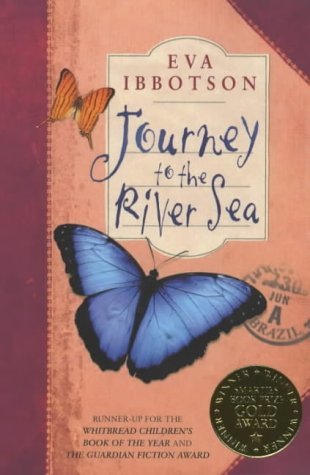
Journey to the River Sea, by Eva Ibbotson

First published in 2001. This edition published in 2002, by Macmillan.


Maia, an orphan, is about to leave the boarding school she has grown up in and start a long sea voyage to Brazil. Up the Amazon River, she will begin a new life with her governess, Miss Minton, and relatives she has never met. In the jungle she will find exotic worlds under the canopy of trees, the colour and life of the local Indians, friendships and adventures like she has never had before. But it can’t all be good, of course, or where would the story be?

Journey to the River Sea is a lovely little story, rich and warm-hearted, with great doses of energy and imagination. The baddies get their come-uppance, the good guys get their happy ending, and everything in-between is uplifting and told with wisdom and humour.

I think perhaps because everything was just as it should be, that I didn’t quite love this as much as I hoped. I found it all just a little too nice and lacking in a bit of pizzazz; although at the same time I can’t really find anything wrong with it. It’s just there is never that sense of danger or intrigue, because I knew, from the tone of the book, that everything would always work out in the end.

I did enjoy the sly digs and knowing humour. It’s great the way Ibbotson took a stab at the ‘baddies’ whenever the opportunity arose – and it’s never nasty, just enough to show them up.

There is a great sense of discovery in Journey, both with Maia discovering what she is capable of, and of a strange and wonderful world waiting to be explored, if only you are brave enough to do so. Actually, the whole book is big on bravery. But the Amazon jungle has a very real presence here, and Ibbotson paints its humidity, its colour, its sound and its secrets with love and energy.

Maia has lots of spirit and enterprise but I really loved Miss Minton – the fearsome old governess with, really, a heart of gold. And not done in a sappy way either. Above all others, I wanted a happy ending for her.

An enjoyable story, with pleasant humour, racing adventure and overall a nicely satisfying quality. I want to read ten ‘children’s classics’ by the end of 2011. This was book one.


Friday, September 16, 2011

The Night Fairy, by Laura Amy Schlitz

First published by Candlewick Press in 2010

There is something very satisfying about holding such high expectations for a book, for quite a long time, and then having them met. The Night Fairy was like that for me. When I first saw it in the bookstore last year, it looked like a classic, it looked like it would be good and something I would enjoy reading. I am not sure exactly how a book ‘looks’ like a classic, but this one did. And I say now that it reads like a classic, without really knowing why – it’s just a feeling you get, I suppose. I really enjoyed The Night Fairy and think it does everything right.

Young fairy Flora is a night fairy, out enjoying the night and her beautiful wings when a bat comes along and accidentally and regretfully bites them off. Flora must then learn to live and adapt to life without wings, discover what she is capable of, and find out that the world can be very big, unfair, and dangerous, and she must do whatever it takes to survive.

The writing in The Night Fairy is simple, but I say deceptively, because there is a lot on stuff going on behind the gentle, lush descriptions and easy language. The writing flows, and it flows wonderfully. We drift towards each part of the garden and each new adventure/discovery and the writing is funny when it needs to be, thrilling when it needs to be, and tender when the moment requires it. There is never a distinctive shift between these changes, it just is, and for me this is the best kind of writing.

And how wonderful it is to see a fictional fairy with so much personality – I think she is a wonderful heroine for young girls. I love that she is feisty and stubborn and even sometimes quite boorish, but still has such a capacity to learn and admit when she may be wrong, without having her morals and beliefs compromised. She is resourceful and smart and determined, but still has compassion and the ability to look beyond her initial misgivings. This was especially prominent in the way she learned to overcome and understand the source of her greatest fear. I also liked how she subtly learned that there is more to her relationships with other creatures  than just what they can do for her in return – Schlitz lets it play out quite winningly and naturally but leave all schmaltziness at the door.

The backyard setting is great, and the way we are introduced to it from the perspective of a fairy not even the size of two acorns. I love when this technique works well – I think it is also a great and imaginative way of teaching kids to think outside the square.

The Night Fairy was a winner for me, and one I would reccommend for every school library. Smart, charming heroine, beautifully simple writing, rich imagination and a story that can teach us things in the best kind of way. 


Wednesday, February 23, 2011

Peter Pan, by J.M. Barrie

I went and bought a copy of Peter Pan the other week, because despite it being just about my favourite book ever, I actually did not own a proper copy.  And by proper, I mean the actual text by Barrie, and not some re-imagined or rehashed or condensed version, because despite the pretty pictures, these versions just can’t come close to the real thing.

Why do I love this book? What is it about Peter and Hook and Tink and the Neverlands that makes me feel so awed and anguished all at once? Sure, I think Barrie has a way with words that completely captivates – a rollicking pace, sly wit, moments of reflection or sadness immediately offset with humour and action so the story, like Peter, immediately darts off in a new and exciting direction. Barrie’s narrative voice is excellent – knowing, interested in words, always considerate of the reader, engaging.
And sure, there is the appeal of running away and never growing up, and playing at adventure and derring-do without any thought for what you have to do with the rest of your life, and then settling for something sub-par anyway (as Barrie, quite poignantly, points out is the case with Mr Darling). There is the glorious nature of the vivacity and cockiness of youth, the blossoming of imagination, of believing things like flying and mermaids and skirmishes with pirates and living in a house in the roots of a tree is not only possible, but also such grand fun. All this is attractive, and captured so piquantly in Peter, this spirited little boy with his leaf and vine clothes and obnoxious crowing and baby teeth, so full of recklessness and excitement and devastating naivety. Barrie writes of Peter Pan that ‘no women has ever yet been able to resist’ and I think this is true of most children, and even adults as well.
But still, this is not why I adore Peter Pan. I love this book because in addition to the all-consuming adventure of it, it is also tragic and cruel and bittersweet. At its heart there are the nuances of loneliness and disappointment, driving Peter ever on in his quest for eternal youth, and many of the other characters as well.
Life is disappointing. We know this. For every shining moment when you just want to burst because everything has gone right, there are about ten disappointments that precede it. To make things attainable, to allow for reality, you often have to put aside other things, including, as Mr and Mrs Darling know, dreams and hopes and wishes. Often other dreams take their place, and often we make the most of and come to love what we do have instead. But it is that moment when you first make that revelation, when you realise that second-best is as good as it’s going to get, that is so sad and tragic and unfair. This subtle, horrible trickling of reality into our dreams and how it affects how we understand the world is really what I think Peter Pan is about: the first contact with the childish mind and the way it continues to resonate well into adulthood.
Peter Pan asks that niggling, aching question of ‘what if’. What if we never grew up? Growing up is exciting, but once you get there you really only want to go back. Wendy does. The Lost Boys, once they become lawyers and office-workers, they do to. Hook is a particularly fascinating case study – Barrie hints that he endured a miserable childhood and realities came rushing in much sooner than most. Hook has grown up, but he is still trapped in the hurts and woes of his childhood, and by pitting himself against Peter he is pitting himself against all the unfairness of his lost youth. At heart Hook is still a boy, dealing out retribution to all those who made him so miserable. Take that – he is a pirate, roaming the seas, living out adventures and mastering epic deeds. But, unlike Peter, he can distinguish between reality and make-believe, and he knows it is all pretence. Peter can brush off consequence and disappointment, Hook cannot. His body is aging but his mind is getting left behind, and he will fail where Peter will always emerge triumphant. All Hook can do, in the end, is show that he battled valiantly, and went to his death (by crocodile!) with good form. And I think, perhaps, that this is where he wins us over, and why he has become such an illustrious villain. He, too, is a victim of disappointment.
Barrie writes joyously of his characters, but he can also be quite perceptively cruel. He variously condemns Mr Darling for being pretentious and pandering, Mrs Darling for being a slave to her children and having ‘no proper spirit’, Wendy for being frivolous, Michael and John for being silly and cold-hearted. His observations of the Lost Boys make fun of them as much as they celebrate all the boys’ quirks. Not even Peter escapes Barrie’s occasional snarky asides. As a technical device this is quite successful, because it invites confidence in Barrie as the authorial voice, establishing intimacy and making us feel like we have one up on the characters, or know something about them that they do not. But it also gives us realistic, well-rounded characters, that not only make for great social commentary but also embellishes them with little niches or faults that cut into us and inevitably leave their mark.
And then, perhaps what I love most about Peter Pan, and what I think was done just so perfectly with the 2003 movie, is the relationship between him and Wendy. They are, I think, made for each other. What is so tragic is that they never get the chance to develop this beyond those intoxicating first stages. Wendy is the only one that would perhaps make ‘growing up’ worthwhile, but, like the best romances, the cost is too high. And really, I think that’s how it should be. They will always be kids playing at pretending to be adults, their relationship will always have the loveliness of possibility, always be caught in that  exquisite netherworld of dreams and make-believe. I think this is beautiful - but I am a sucker for a tragic ending. These are the ones that stay with me long after the last page.
Peter needs to be on his own. He cycles through his subjects, his companions (the gorgeous Tink), he defeats his arch-nemesis’ and promptly forgets about them. Reality does not leave its mark. He doesn’t, really, know who he is, only in relation to who he must fight and what adventure he must have, and when that’s over he begins again, and all he remembers is that he was brilliant and everyone adored him, but with no one lasting or meaningful to celebrate with him, he must go and ecstatically prove it all over again. Peter Pan is the epitome of escapism. He soars off the page and we can never quite catch him, but our lives are a little bit better for knowing he was there.


Tuesday, September 28, 2010

Peter Pan

...Hook found himself face to face with Peter, and the others drew back. The two enemies looked at each other for a long time. Hook shuddered slightly, but there was a smile on Peter's face.
   "So, Pan," said Hook, at last. "This is all your doing."
   "Aye, James Hook," Peter answered, "it is all my doing."
   "Then prepare to meet your doom, my cocky boy," snarled Hook.
   "Have at you," cried Peter, and the fight began.
One of my all-time favourites is the incomparable Peter Pan, by J. M. Barrie. This is a beautiful, beautiful story, rich in theme, that just about breaks my heart every time. Peter Pan, Tinkerbell ('You silly ass!') and Captain Hook are such fantastic, layered characters. P.J. Hogan's 2003 live action movie version is also one of the most stunning kids films you will see, and Jeremy Sumpter as Peter Pan is perfect.