Showing posts with label 10 CC 2011. Show all posts

Monday, December 26, 2011

The Neverending Story by Michael Ende

First published in German, 1979

What an important, amazing and imaginative book The Neverending Story is. It’s been a long time since I’ve read a book that can balance such magic and imagination with such insight and perception into the human psyche and the real world, and have the two inform understanding of the other. And then, above all, to do it within the framing device of the central character literally stepping into a book that teaches him all these things, and at the same time relies on him to keep creating the stories within. So clever, and so much fun.
I have read Momo by Michael Ende, and wasn’t such a fan – it was just a little too preachy and twee for me. The Neverending Story has a similar sort of intellectual whimsy, but I found I could stomach it better. Perhaps because the over-arching message is quite beautiful, and the way the central figures, Bastian and Atreyu, discover these things is through exposure to such wonderful things and creatures, whose beauty and magic helps them realise very human things like courage and individualism and selflessness and my personal favourite, imagination. When the fantastical comes to reflect and impact on the real, this is my kind of story.
To begin with I found The Neverending Story a little fussy – there was so much going on, and I wasn’t quite feeling the writing style (especially the parts told wholly in italics!), and there were so many strange creatures coming and going that I had to keep reading back to keep up. But as soon as Cairon the centaur went to find Atreyu, then I got swept up in his quest and all the fabulous lands Ende takes us to and the even-more fabulous creatures he has us meet. And I also didn’t mind Ende’s plot device of ‘but that’s another story and shall be told another time’ – this reinforces the idea of the book living on long after we close the pages (the neverending story), of wonderful things still to discover and stories to tell.
The Neverending Story has a lot of colour and vibrancy. It seems Ende’s imagination never runs out. The places we go to are not the same old places we might find in a fantasy book (not that there’s anything wrong with that), but just marvels of strangeness and wonder. In this way, The Neverending Story reminds me of The Phantom Tollbooth. We go from the magnificent, like the Sphinxes guarding the three gates, to the spectacularly strange and creepy, like Spook City, to long ladders formed out of letters of the alphabet, to the beauty of Perilin, the Night Forest. And then all the creatures we discover inbetween – it never ends, and it never feels like too much. One of my favourites was the idea that forgotten dreams fall out of a person’s sleep and into the earth where they are mined, and collected, waiting for the moment when a person needs them again. I love it when an author  can take something from the human world that we don’t really think about much, and turn it into something entirely new and full of meaning.
This book also has a lot of heart. It feels like Ende really did have a lot to say about the power of the book and of the imagination, and a way of making you believe it yourself. The Neverending Story is also full of themes, but the big ones concern memory and choice, power and compassion. I wasn’t such a fan of Bastian in the real world (I found those scenes just a little too sentimental), but in Fantastica his story is powerful and engaging.
And this book also has much sadness, which I love. I love the tragically beautiful in books and movies. I love when characters come to an end that isn’t wholly sad, but certainly bittersweet. This, I find, is when the worlds and creatures authors create come the closest to real life.
And so I loved Morla, who has lived so long she finds the world ‘empty and aimless’, who knows so much that ‘nothing really matters anymore, because it’s all the same’. And I loved the Spook City ghosts who leapt into the nothing because they have given up hope and become weak. And Gmork, the bitter old werewolf.  And the City of Old Emperors, whose inhabitants have used up all their memories and so wander around aimlessly, because ‘without a past they can’t have a future, and they can never change so nothing changes for them’. What a sad, beautiful idea. And of course Dame Eyola, who waits so long for Bastian and then gives him all of her love and affection so that all her vibrancy wilts and she becomes like a ‘black, dead tree’.
I have seen The Neverending Story film of course, but I am so glad I’ve now read the book. I did like the first half (the movie half) better for adventure and excitement, but I found that the second half really reinforced the thematic material, and was just as important in its own right. A wonderful book that should not be forgotten, because in every way it reinforces the idea of what a book is really about.

Tuesday, November 15, 2011

The Graveyard Book, by Neil Gaiman

This edition published in hardback by Bloomsbury, 2008.


I do love me some Neil Gaiman - he has done some terrific, wacky, original and touching (especially his shorter fiction) stuff over the years. And as a lover of children's fiction, The Graveyard Book has been on my radar since its release - even if I've only got to it now!

On the night his family is murdered, a toddler wanders into a graveyard, where the ghosts and supernatural residents who live there agree to raise him as one of their own. Bod, as he is named, grows up with all the dangers and adventures possible in a graveyard, but he is not allowed to leave - or the man Jack, who killed Bod's family, will kill Bod too.

Although The Graveyard Book was all the things I thought it would be - clever, magical, well-written, quirky - for me it lacked an emotional punch. I wanted it to kind of chew up all my emotions, as well as my imagination - like the best fantasy does. But I feel like it never quite got there.

Although certainly creative and well-written, I think the way The Graveyard Book is written might be part of the reason why I never really fell in love. It's very episodic, each chapter concerning an event every two years in Bod's life, with the threat of the man Jack hanging loosely over everything. Each chapter could be a short story, in fact I'm sure I have read some of the chapters in short story compilations, and all throughout the book I was in that weird, sometimes annoying state of going, 'I'm sure I've read this before.'

Gaiman's books have such a wonderful folklorish feel to them, and that is certainly present here. It's a special kind of gritty whimsy. The chapters about the ghoul-gate and the danse macarbe are the best kind of creepy and lovely respectively. That sense of the other, of longing for fantastic worlds just out of reach, is done with a great sense of understanding and love.

Gaiman's secondary characters are always a joy - I especially had a lot of love for Silas, Miss Lupescu and Liza. They are the kind of strange, mysterious and charming characters we make stories about as a kid. They, and others, provide just the right amount of wisdom and fun.

There are, of course, obvious metaphors - namely Bod growing up and learning about the world outside the graveyard, learning from his own mistakes, is reflective of any young person's journey into the unfamiliar world of adulthood. This is never done in twee or over-the-top ways. Bod is often thoughtless and makes mistakes but we see throughout the book how he learns from them and respects those he does ask for advice. The mistakes he makes always seem justified because we are put so fully in his head that we understand them - this is great, effective writing. Bod is quite an endearing little character and we see how his life and actions are enriched by others.

The Graveyard Book is lots of fun with some widsom and depth to boot, but not quite the emotional attachment to tie it all together. Book two in my quest to read 10 children's classics before the end of the year. Recommended.

Thursday, November 3, 2011

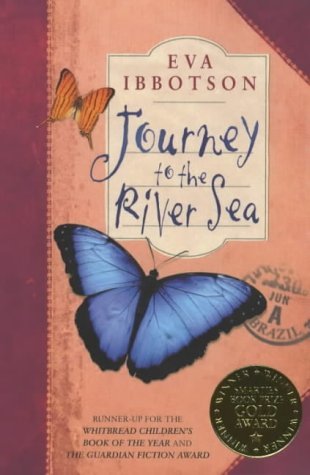
Journey to the River Sea, by Eva Ibbotson

First published in 2001. This edition published in 2002, by Macmillan.


Maia, an orphan, is about to leave the boarding school she has grown up in and start a long sea voyage to Brazil. Up the Amazon River, she will begin a new life with her governess, Miss Minton, and relatives she has never met. In the jungle she will find exotic worlds under the canopy of trees, the colour and life of the local Indians, friendships and adventures like she has never had before. But it can’t all be good, of course, or where would the story be?

Journey to the River Sea is a lovely little story, rich and warm-hearted, with great doses of energy and imagination. The baddies get their come-uppance, the good guys get their happy ending, and everything in-between is uplifting and told with wisdom and humour.

I think perhaps because everything was just as it should be, that I didn’t quite love this as much as I hoped. I found it all just a little too nice and lacking in a bit of pizzazz; although at the same time I can’t really find anything wrong with it. It’s just there is never that sense of danger or intrigue, because I knew, from the tone of the book, that everything would always work out in the end.

I did enjoy the sly digs and knowing humour. It’s great the way Ibbotson took a stab at the ‘baddies’ whenever the opportunity arose – and it’s never nasty, just enough to show them up.

There is a great sense of discovery in Journey, both with Maia discovering what she is capable of, and of a strange and wonderful world waiting to be explored, if only you are brave enough to do so. Actually, the whole book is big on bravery. But the Amazon jungle has a very real presence here, and Ibbotson paints its humidity, its colour, its sound and its secrets with love and energy.

Maia has lots of spirit and enterprise but I really loved Miss Minton – the fearsome old governess with, really, a heart of gold. And not done in a sappy way either. Above all others, I wanted a happy ending for her.

An enjoyable story, with pleasant humour, racing adventure and overall a nicely satisfying quality. I want to read ten ‘children’s classics’ by the end of 2011. This was book one.